Traffic jams have indeed become an important problem in many parts of the world, affecting millions of people every day. There are many reasons for this problem, especially with the increase in urban population. Along with the increase in population, the number of cars on the roads has also increased. Today, far more people own their own cars than ever before, allowing for rising incomes, urbanization and personal transportation. Due to the poor state of mass transit in many places, when buses, trains, etc. are incredibly crowded, or not available at all, people prefer to go by their own cars. That causes more cars to block the roads, slowing down buses or trucks. Cities designed several decades ago were often not built to handle this volume of cars, creating narrow roads. Therefore, narrow roads cannot hold the crowd of passengers during rush hour. In addition, road construction exacerbates the problem of traffic jams. Such works often reduce roads or block roads entirely, making the road narrower for vehicular traffic. Bad weather such as rain, snow, or fog causes accidents which is another cause of traffic jams. One small accident can cause miles of traffic jams in a matter of minutes. The result of many people trying to use the same road at the same time is traffic congestion problems (e.g. morning and evening hours). Being stuck in a jam results in increased fuel consumption, higher emissions, and poorer air quality as the engine idles. Some studies have linked pollution from traffic to health problems like asthma or heart disease, especially in dense urban areas. Being stuck in traffic jams for long periods of time also increases stress levels. Some cities have measures such as congestion pricing, or Metro, as a way to solve this problem. To get some distance from such problems, technologies like real-time traffic apps help drivers avoid the worst, i.e., places with high traffic congestion.
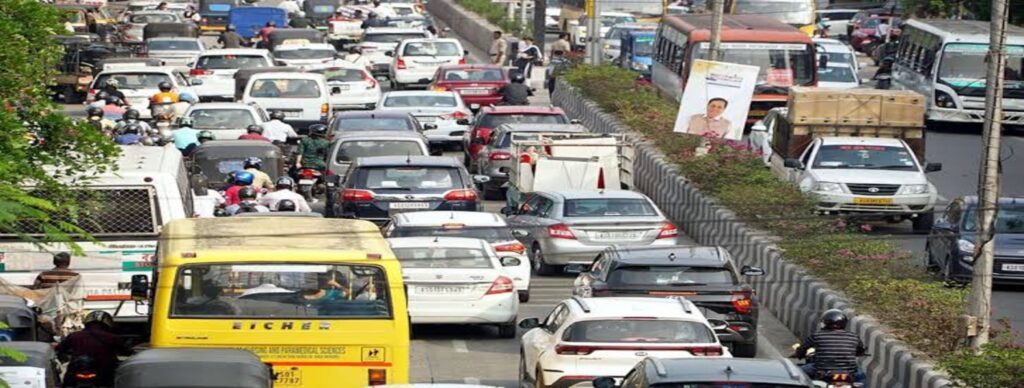
In 2023, Bangalore ranked 6th globally for traffic congestion, and Pune ranked 7th. A few years ago, Bangalore was ranked as one of the worst cities in India in terms of traffic, but now it is second only to Kolkata in terms of congestion in India. Narrow roads, high population density, and increasing number of vehicles create severe traffic problems in cities like Kolkata. According to the 2024 TomTom Traffic Index, the top five cities in India are Kolkata, Bangalore, Pune, Hyderabad and Chennai.
Assam is also connected by many national highways including state highways connecting different parts of the state. The major modes of transportation in Assam are roads, railways, airports, and inland waterways. Dispur (Guwahati), the capital of Assam, is especially known for traffic jams and heavy traffic, and therefore has a high number of road accidents. Guwahati Traffic Police has an official Twitter handle (@GhtyTrafficPol) for traffic updates and announcements. Guwahati, the largest city in Assam and known as the “Gateway to the North East”, faces heavy traffic congestion due to its rapidly growing population, increase in traffic, and limited road capacity. Construction of new roads to increase road capacity, narrowing of traffic lanes due to flyovers, and other infrastructure projects cause traffic jams in other parts of the city. Inside the city, sometimes conditions get so bad that walking all the way seems more reasonable than taking a car or bus. By mid-2023, the population of Guwahati was about 13.25 lakh. In contrast, according to a report by The Sentinel Assam (July 10, 2023), the number of registered vehicles in the city was about 1.3 million (3 lakh four-wheelers, 6 lakh two-wheelers and 4 lakh other vehicles like commercial, auto-rickshaws). Problems arise. It is estimated that 4,000–5,000 new vehicles are registered every year, putting excessive pressure on the roads of the city. With almost one vehicle for every resident, the roads in Guwahati are overly congested. The preference for private rather than public transport has further complicated the situation. The main roads of Guwahati—GS Road, Zoo Road, GNB Road and Shilpukhuri Road—form the backbone of the city’s transport system. There is also heavy traffic jam in areas like Six Mile, Ganeshguri, Maskhwa, Pan Bazar, Paltan Bazar, Chandmari and Guwahati Club. During certain hours (between 9–11 am and 5–7 pm) travel time through the city increases significantly. According to a report by Sentinel Assam, people on their way to work are stuck in traffic jams for an average of 2–3 hours a day. Although the problem is well known, it is increasing rather than decreasing. This is a complex problem, and we must all work together to solve it.